Konstantin Krimmel steps in for Andrè Schuen at short notice at the Schubertiade – and, together with Daniel Heide, turns Brahms’ Die schöne Magelone into a musical, narrative and surprisingly entertaining event.
Sometimes a last-minute cancellation can be the best thing that happens to an audience. Not, of course, for the artist who has fallen ill – but certainly for those who suddenly find themselves witnessing an evening that was never planned this way and, precisely for that reason, may remain in the memory for a long time.
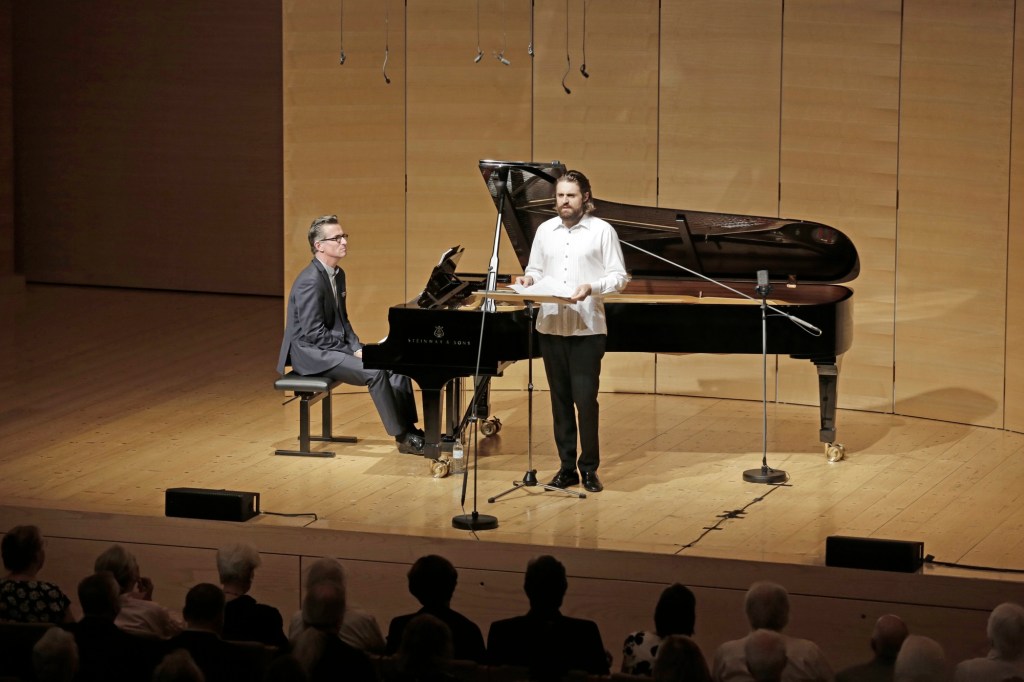
On 24 August, just such a stroke of luck occurred at the Schubertiade in Schwarzenberg. Andrè Schuen had to cancel his recital at the Angelika Kauffmann Hall due to illness. Konstantin Krimmel promptly extended his stay and, together with Daniel Heide, took over Johannes Brahms’ Die schöne Magelone, Op. 33 – all fifteen romances based on Ludwig Tieck.
Stepping in at short notice is never a challenge for the singer alone. The pianist, too, has to adjust within a very short time to a different partner, a different voice, different breathing patterns, tempi and interpretative ideas. In this case, there was an additional challenge: as Krimmel told me in a brief conversation while signing autographs after the concert, the Magelone originally prepared for Schuen was performed a whole tone lower for him. A remarkable additional achievement on Daniel Heide’s part.
And yet, what emerged felt anything but like an emergency solution.
Even before Krimmel sang his first note, the evening acquired a very human dimension. In a brief address, he wished his ailing colleague a speedy recovery and modestly said that he would do his best to be a worthy replacement. The audience responded with warm applause.
Krimmel then announced another surprise: he would not only sing Brahms’ fifteen romances but would also recite the connecting passages from Tieck’s story himself – a “free upgrade”, as he charmingly put it.
And that upgrade proved to be one of the evening’s greatest assets.
When the Singer Becomes the Storyteller
Brahms’ romances do not tell the story continuously. Rather, they form emotional landmarks along the way: departure, falling in love, happiness, doubt, separation, longing and reunion. Krimmel’s narration transformed them into a coherent whole: the spoken word told us what happens; the music allowed us to experience what it does to the people involved.
Moving between narration and song requires considerable flexibility. The speaking voice needs naturalness and narrative flow, while moments later the singer must return to musical breath, legato and vocal line.
Krimmel managed these transitions with remarkable ease. Alongside his warm baritone, one discovered a beautifully soft and expressive speaking voice. Elegant and modest, yet with a quietly compelling stage presence, he established an immediate connection with the audience.
Krimmel has by now become almost inseparable from the Schubertiade, where his artistic development has been fascinating to follow over the years. His diction is impeccable, his legato flowing, his phrasing organic, his dynamics finely differentiated and never exaggerated.
He sings as though effort simply did not exist.
At the same time, his interpretations have gained maturity. Behind the beauty of the voice and his technical assurance, one increasingly hears a depth that comes not from technique alone, but from artistic and human experience.
A Pianist Who Sings Along
In Daniel Heide, Krimmel had his trusted piano partner at his side: two artists who are thoroughly attuned to one another while retaining their individual musical personalities.
Heide does not simply accompany. He sings along.
His playing is delicate, attentive and never overstated, yet present at every moment. In Brahms especially, the piano is far more than accompaniment: it comments, intensifies moods and continues thoughts long after the voice has fallen silent.
That Heide achieved all this under the conditions of a last-minute change of singer – and with the additional transposition – made his performance all the more remarkable.
Peter, Magelone – and the Thing About Men
And then there is the story itself.
The young knight Peter leaves his parents’ home in search of adventure and meets the beautiful princess Magelone. They fall in love – although Magelone is clearly the more proactive of the two: she kisses the knight first. He simply does not dare. Peter weeps with happiness – and starts to sing.
Peter is, in fact, a rather appealing character: courageous, passionate and full of drive. Foresight, however, is not always his greatest strength.
During their escape together, Magelone falls asleep in the forest. Peter busies himself with the three rings he once gave her, a bird snatches them away – and before long, not only the rings but the knight himself has disappeared. Peter ends up at sea and eventually in a foreign land.
Magelone, meanwhile, wakes up alone and discovers that her handsome knight has vanished.
Men!
Peter, for his part, is remarkably fortunate. Far from home, he is not treated as an enemy but welcomed kindly. A new romantic possibility even begins to emerge with the Sultan’s daughter, Sulima. Yet Peter longs to return home.
Eventually, he encounters a beautiful blonde woman – and, after some two years of separation, initially manages not to recognise his own Magelone.
But Magelone forgives him. The two are reunited.
So this is no Romeo and Juliet story, but rather a Romantic tale of chivalry, adventure and love – fortunately with a happy ending. At the same time, it is the story of a young man who sets out courageously, repeatedly acts on impulse and gradually matures through his adventures.
More Than a Replacement
A last-minute substitution became an evening filled with music, humour and humanity. Krimmel’s combination of narration and song turned Brahms’ romances into something close to a one-man theatre piece with piano.
The enthusiastic applause seemed reluctant to end.
Konstantin Krimmel had stepped in as a replacement. What the audience received was a stroke of luck.

