Verdi’s “Messa da Requiem” with C.H.O.I.R. 2026 at the Liebfrauenkirche in Ravensburg
Ravensburg, 16 August 2026
By Oxana Arkaeva
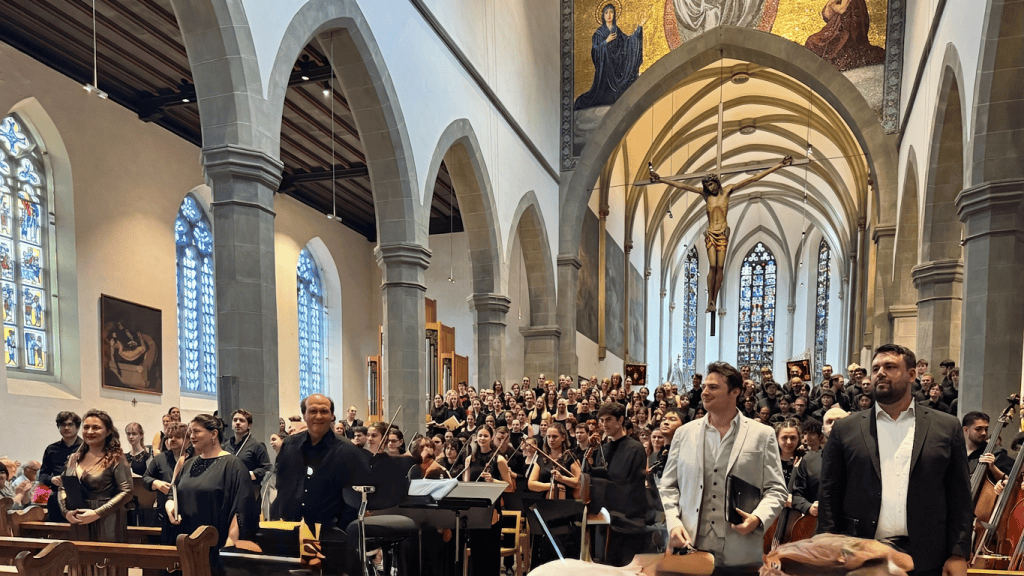
Around 190 young singers from eleven regions, eleven days of rehearsals together – and one of the most demanding works in the choral-symphonic repertoire. What might sound like an ambitious international youth project developed into a performance of exceptional quality at Ravensburg’s Liebfrauenkirche on Sunday evening.
Under the direction of Michael Alber, the C.H.O.I.R. 2026 Festival Choir and the Era Nova Orchestra, Budapest performed alongside Maryna Zubko (soprano), Jasmin Etminan (mezzo-soprano), Joshua Owen Mills (tenor) and Martin Summer (bass).
Grief Becomes Music
Verdi’s Messa da Requiem was born out of personal grief and admiration. Following the death of the Italian writer Alessandro Manzoni, whom Verdi greatly revered, in 1873, the composer decided to dedicate a Requiem Mass to his memory. The work was premiered under Verdi’s own direction at the Church of San Marco in Milan on 22 May 1874, the first anniversary of Manzoni’s death.
The Requiem is the Mass for the Dead in the Roman Catholic liturgy: a prayer for the departed that speaks of death and judgement, but also of redemption and the hope of eternal life.
More than 150 years later, these words have acquired a disturbing new relevance. Against the backdrop of the war in Ukraine and other armed conflicts around the world, it was difficult to hear Verdi’s Requiem that evening merely as a historical masterpiece. It also felt like a Mass for the Dead for all those who have lost their lives innocently in these wars.
The fact that the work was performed in the Catholic Liebfrauenkirche intensified this impression. The church’s excellent acoustics gave the large ensemble space and resonance while preserving the music’s finer structures.
190 Voices – Yet Sheer Volume Is Not the Goal
Of course, around 190 voices can produce tremendous power. More impressive, however, was how little this choir needed to rely on sheer volume.
The Festival Choir impressed with its homogeneous sound, outstanding articulation and remarkably subtle dynamic shaping. Even in the great climactic passages, the music retained its differentiation. The famous Dies irae had tremendous force without becoming a mere display of effect.
For an internationally assembled youth choir to achieve such cohesion after only eleven days of rehearsals together is a remarkable accomplishment.
Michael Alber – Great Impact Through Subtle Gesture
A considerable share of the credit belongs to Michael Alber. The former Chorus Director of the Stuttgart State Opera and current Professor of Choral Conducting at the Trossingen University of Music guided the enormous forces with refined gestures and without ostentatious effects.
Choir and orchestra were sensitively attuned to one another. The Era Nova Orchestra, Budapest proved an equal partner: where Verdi demanded it, the orchestra took the lead; elsewhere, it sensitively stepped back, giving the choir and soloists room to unfold.
Only some of the tempi felt slightly sluggish on this hot summer evening – perhaps the high temperatures were not entirely without influence. Overall, however, the performance was distinguished by finely judged and precise musical preparation.
Four Voices – One Ensemble
The quartet of soloists was equally convincing. Maryna Zubko, Jasmin Etminan, Joshua Owen Mills and Martin Summer possess distinctly individual voices, yet they blended with striking naturalness into a unified ensemble. All four share a notable beauty of tone – something that should by no means be taken for granted in a quartet of such contrasting voice types.
Joshua Owen Mills was particularly compelling. His tenor combines excellent vocal technique with a high degree of musicianship. The voice is focused and resonant in the mask – la maschera perfetta – while retaining the ability to produce a genuine, well-supported piano. In the Ingemisco, Mills combined power with sensitivity, shaping the music with exceptional dynamic nuance and refinement.
Jasmin Etminan impressed with a rich, full-bodied and pleasing mezzo-soprano supported by a solid technique. Only in the upper register did the sound occasionally become somewhat broad and unfocused.
With soprano Maryna Zubko, it was above all her almost soaring pianissimi that impressed. At the same time, her voice now possesses the substance and carrying power of the dramatic repertoire. It was precisely this combination of dramatic presence and floating soft singing that gave her interpretation its tension.
Bass Martin Summer, in turn, united apparent opposites in the Confutatis: powerful yet tender. His bass possessed authority and a firm foundation without relying on vocal heaviness.
Excellence as an Educational Mission
Behind this achievement stands the Landesakademie für die musizierende Jugend in Baden-Württemberg in Ochsenhausen. C.H.O.I.R., which celebrates its 30th anniversary in 2026, brings together young singers from different regions of the world to work together at a high musical level.
Projects like this may be among the best experiences young musicians can have: they encounter professional standards while learning that musical excellence can only emerge through listening, individual responsibility and working together.
It is equally remarkable that a concert on this scale is offered with free admission. Public funding thus makes possible not only high-level musical education, but also broad access to culture.

“That is our mission: to make high-level education accessible to everyone,” sais the Academy’s Director, Prof. Dr. Klaus K. Weigele, summing up this philosophy in a personal conversation.
At a time of growing social and geopolitical tensions, this mission acquires additional significance. The Landesakademie itself describes C.H.O.I.R. as a “utopian counter-model.” That evening, one could experience what those words mean.
Excellence Without a Youth Bonus
The crucial point about this performance was that there was no need to grant it any special allowance for youth.
A homogeneous choir with excellent articulation, a sensitive and equal orchestral partner, four distinctive yet beautifully harmonised solo voices, and Michael Alber’s finely judged musical direction made Verdi’s Requiem a deeply impressive experience. And at a time when people continue to lose their lives in wars every day, Verdi’s more than 150-year-old Mass for the Dead acquired a haunting contemporary relevance.
That evening, around 190 young people became one collective voice. Perhaps this is where the most powerful message of this Requiem lies: to listen, to respond to one another, and to breathe together.
Oxana Arkaeva
#Verdi #VerdiRequiem #MessaDaRequiem #CHOIR2026 #MichaelAlber #MarynaZubko #JasminEtminan #JoshuaOwenMills #MartinSummer #EraNovaOrchestra #ClassicalMusic #ChoralMusic #Choir #YoungMusicians #MusicConnects #MusicUnites #MusicEducation #CulturalEducation #LiveMusic #ConcertReview #ClassicalMusicReview #Ravensburg #Liebfrauenkirche #LandesakademieOchsenhausen

