Wagner’s Rienzi makes its Bayreuth debut in the Festival’s anniversary year – musically overwhelming, theatrically caught between contemporary relevance and visual overload
Performance on Augustus 19th, 2026
By Oxana Arkaeva
It has taken 150 years. In the anniversary year of the Bayreuth Festival, Richard Wagner’s once most successful opera finally makes it onto the stage of the Festspielhaus for the first time: Rienzi, the Last of the Tribunes. It is a remarkable event – not only because of the work’s difficult reception history, but also because it allows us to discover a Wagner who is not yet the Wagner of Tristan, the Ring or Parsifal. And yet, surprisingly often, that later Wagner can already be heard.
Rienzi was Wagner’s third completed opera and his first overwhelming success on stage. Its 1842 premiere in Dresden brought the young composer sudden fame. Musically, he was still strongly influenced by French grand opéra, particularly Meyerbeer: monumental choral tableaux, political conflicts, processions, battles, grand finales and a spectacular juxtaposition of the individual and the masses.


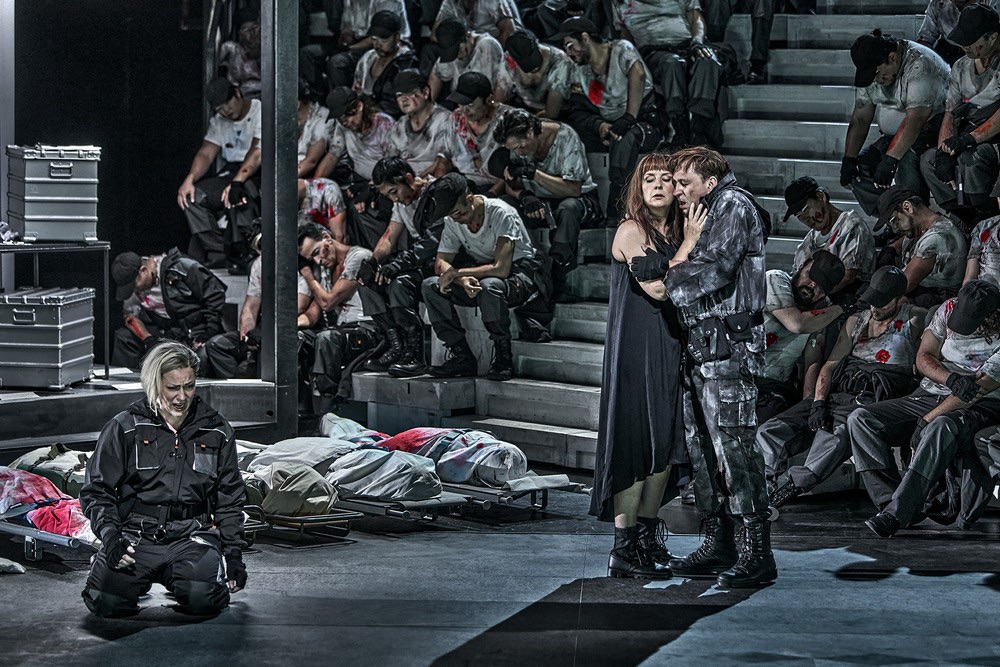
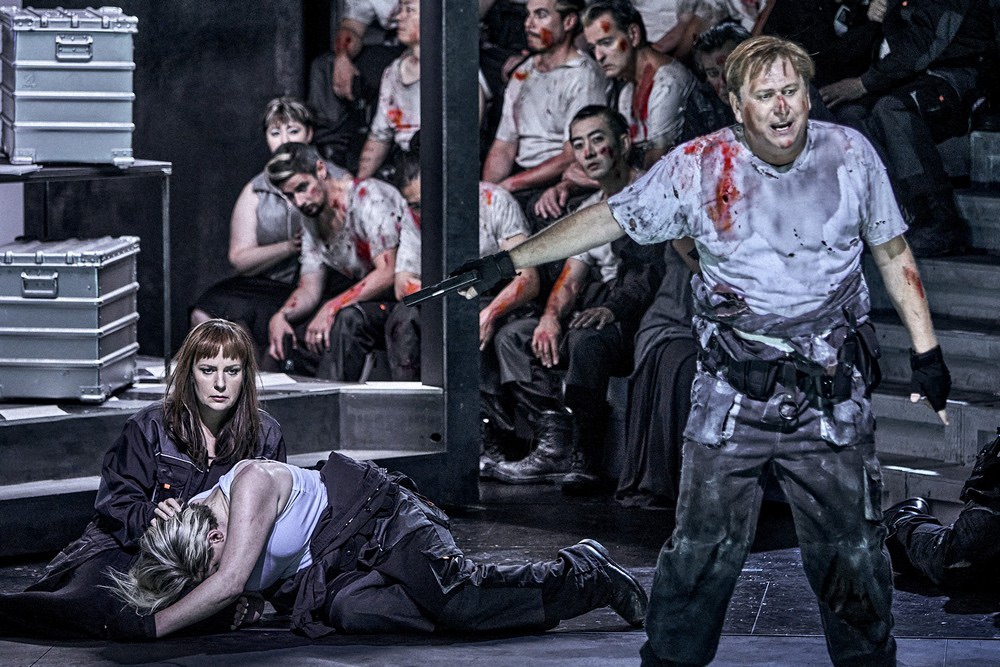

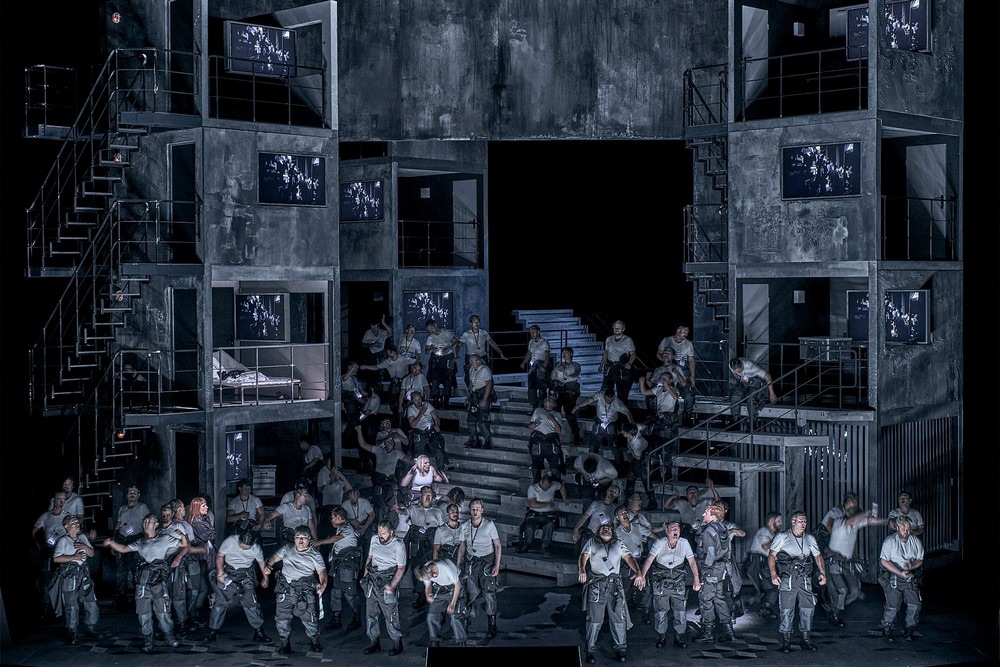


At the same time, the later Wagner is already unmistakable. In the orchestral transitions between the acts, in recurring musical ideas and, above all, in Rienzi’s famous prayer “Allmächt’ger Vater, blick herab” (“Almighty Father, look down upon me”), one can already sense the kind of musical and psychological concentration Wagner would later develop in works such as Tannhäuser and Parsifal.
From bearer of hope to prisoner of his own power
The historical Cola di Rienzo sought to break the power of Rome’s rival aristocratic families in the fourteenth century and establish a new political order. Wagner turns his story into that of a man elevated by the people into a figure of hope – only to be destroyed by the very power they have bestowed upon him.
The production by Alexandra Szemerédy and Magdolna Parditka, making their Bayreuth debut with Rienzi, radically transports the story into the present. Election campaigns, an omnipresent social-media culture, fake news, media manipulation, war and political self-promotion define their dystopian world.
The monumental set consists of cubic living units reminiscent of concrete apartment blocks. The underlying Necker cubes play with our perception: What is inside and what is outside? What is reality and what is construction? It is an apt metaphor for a society in which truth is increasingly generated and shaped by the media.
Screens continuously broadcast faces, news and events. The masses watch, film, comment and pass judgement. At first, Rienzi masters these mechanisms – until he himself becomes their prisoner and is ultimately destroyed by them.
Too many images for an already monumental opera
The directing duo creates some powerful images. Yet this is precisely where the production also encounters its greatest problem.
Election campaigns, live video, smartphones, fake news, war, gender fluidity, religious visions, Bauhaus aesthetics and political allusions are constantly competing for attention. Wagner’s already monumental music is confronted with a second monumentality – a visual one. Eventually, one hardly knows where to look.
In a work of this length, the relentless density of stimuli paradoxically creates distance rather than greater involvement. Much of it is intelligently conceived, some of it spectacular to watch – yet emotionally, the production remains surprisingly remote.
For Bayreuth, the work – originally comprising more than five hours of music – has been shortened by approximately one third. Nevertheless, repetitions, longueurs and moments of theatrical inertia remain.
Nathalie Stutzmann – the musical pillar of the evening
That this production holds together at all is due above all to Nathalie Stutzmann.
She is the musical centre of the performance. Under her direction, the Bayreuth Festival Orchestra achieves remarkable transparency despite its large forces. Brass and strings remain beautifully balanced; intimate moments are given room to breathe without diminishing the impact of the monumental climaxes. Still clearly recognizable as a number opera, Rienzi allows us to listen to a composer in the process of becoming Wagner.
Above all, Stutzmann listens to her singers. With a role such as Rienzi, this should not be underestimated. As a singer herself, Stutzmann knows the physiological demands placed upon a voice and seems to understand exactly when the orchestra needs to support, when it must withdraw, and when it can virtually lift the stage.
The orchestra thus becomes a dramaturgical partner, bridging some of the production’s theatrical voids. Stutzmann allows the later Wagner to emerge without artificially turning Rienzi into the Ring.
Andreas Schager – a Rienzi of extremes
And then there is Andreas Schager.
What this role demands of a tenor, borders on vocal high-performance sport. Power, top notes, projection and, above all, stamina must remain available for hours. Schager does not merely meet this challenge – he masters it.
His darkly grounded timbre has focus and enormous carrying power; the upper register remains secure and his diction clear. More impressive than the sheer power, however, is his ability repeatedly to find his way back to legato, piano singing and dynamic differentiation.
The musical high point comes with Rienzi’s prayer, “Allmächt’ger Vater, blick herab.” For a moment, the tribune disappears. What remains is a broken human being. Schager scales back his voice, revealing intimacy and vulnerability – and creates one of the most moving moments of the evening.
Dramatically, too, he traces a convincing development: from idealist to celebrated tribune, from an increasingly driven ruler to a murderer and, finally, an isolated human being.
Three voices at the centre
Alongside him, Gabriela Scherer as Irene and Jennifer Holloway as Adriano prove more than equal to the enormous vocal and dramatic demands placed upon them.
Scherer is an elegant and intense Irene, with a rich vocal colour, beautiful legato and a secure upper register, although a pronounced vibrato is occasionally impossible to ignore. The production transforms the sibling relationship between Rienzi and Irene into an erotic one and, together with Adriano, creates a fluid love triangle. This “unhealthy” relationship is deliberately given greater psychological weight, suggesting in advance the relationship between Siegmund and Sieglinde in Die Walküre.
Holloway shapes Adriano with considerable dramatic intensity. Her stable middle register and fine legato combine with a somewhat broader upper range in a voice capable of moving convincingly between lyrical and dramatic expression. Above all, she makes Adriano’s dilemma between love, family and political loyalty credible and deeply human.
And then there is the Bayreuth Festival Chorus. It is not mere accompaniment but one of the principal characters in this Rienzi: homogeneous, secure in intonation, rhythmically precise and outstanding in its articulation.
Most importantly, the chorus succeeds in giving the masses many different faces – enthusiasm, adoration, demand, aggression and, finally, brutality.
The right Rienzi for 150 years of Bayreuth?
Precisely because of its controversial history, Rienzi may be the right work for this anniversary.
The frequently repeated claim that it was Hitler’s “favourite opera” cannot be historically substantiated. What cannot be disputed, however, is the work’s appropriation by National Socialism and the particular burden this has placed on its reception history.
Bayreuth 2026 does not attempt to evade that past. Instead, the production raises questions that extend far beyond it: How is charisma created? Why do people transfer responsibility to political figures whom they invest with almost messianic hopes? When does leadership turn into seduction? And how quickly can the masses turn against the very person they themselves have elevated?
Musically, this Bayreuth premiere is an event. Theatrically, it remains at a distance despite – or perhaps because of – its flood of images.
And yet this Rienzi is worth experiencing. Perhaps precisely because it is not perfect.
For somewhere between grand opéra, number opera and the first beginnings of music drama, we hear a young composer searching for his own language.
Before Wagner, there was already Wagner.
Bayreuth Festival · 19 August 2026
Richard Wagner: Rienzi, the Last of the Tribunes
Grand tragic opera in five acts
Libretto: Richard Wagner
Based on Edward Bulwer-Lytton’s novel Rienzi, the Last of the Roman Tribunes
Composed mainly: 1838–1840
World premiere: 20 October 1842, Royal Court Theatre Dresden
2026 Production
Conductor: Nathalie Stutzmann
Staging: Alexandra Szemerédy,Magdolna Parditka
Stage design: Alexandra Szemerédy,Magdolna Parditka
Costumes: Alexandra Szemerédy,Magdolna Parditka
Light: Bernd Gallasch
Video: Leonard Koch
Dramaturgy: Markus Kiesel
Choir: Thomas Eitler-de Lint
Cola Rienzi, papal notary: Andreas Schager
Irene, his sister: Gabriela Scherer
Steffano Colonna, head of Colonna family: Andreas Bauer Kanabas
Adriano, his son: Jennifer Holloway
Paolo Orsini, head of Orsini family: Michael Kupfer-Radecky
Cardinal Raimondo, papal legate: Vitalij Kowaljow
Baroncelli: Matthias Stier
Cecco del Vecchio: Joachim Goltz
A peace messenger: Victoria Randem

