Theatres as Sanctuaries of Real-Life Connection — Frank Hilbrich’s Theatre Vision!
Interview by Oxana Arkaeva for Opera-Views.net | Bremen, May 9, 2025
Spanisch version Deutsche Version
Frank Hilbrich (b. 1968) stands out among German-speaking opera directors for his blend of rigorous craft and social engagement. From his start at Theater Bremen, where he is currently acting as Head Director of Music Division and part of the artistic leadership team, Hilbrich has championed diversity, community dialogue, and sustainable artist development.
Whether nurturing young talent or reimagining classics, he sees theatre as a dynamic forum where artists and audiences co-create meaning. As he embarks on his journey in Gelsenkirchen, his philosophy offers a blueprint for a more inclusive, reflective, and connected future for music theatre.
Beginning in the 2026/27 season, Frank Hilbrich will step into his new role as Generalintendant of Musiktheater im Revier (MiR) in Gelsenkirchen.

Opera-Views: You’ll begin as Generalintendant in Gelsenkirchen next season. What excites you most about the city, theatre, and your new role?
Hilbrich: Gelsenkirchen—a major city in the heart of North Rhine-Westphalia’s Ruhr region and part of the Rhine-Ruhr metro area—fascinates me as both a performing-arts venue and a cultural hub.
Here, I see the chance of sustainable decision-making and to redefine what theatre means for a diverse local people. The theatre audience is rapidly evolving; it is becoming more diverse and is no longer limited to the traditional educated middle class. New themes, perspectives, and expectations are emerging that we must reflect and address. With MiR’s large and small stages dedicated to music theatre and dance, we can present grand opera alongside intimate, cross-genre projects. That flexibility is essential: traditional opera alone – as much as I love it – no longer suffices to connect with today’s public.
Opera-Views: In the spirit of “I have a dream,” what is your vision for the future of music theatre?
Hilbrich: My dream is for music theatre to be a space of social reflection, co-created by artists and audiences alike. We must shed elitist notions and embrace new works, stories, and forms of expression. Theatre should spark debate, foster empathy, and mirror society’s challenges. My role is to ignite these processes—providing impulses, resisting artistic rigidity, and ensuring every production resonates with contemporary life.
Opera-Views: How do you approach reinterpreting historical works for today’s audiences?
Hilbrich: I commit to “old school” rigor: extensive repeated reading, listening, and score study. Then I ask, myself, ‘Does this piece move me? Does it resonate with me?’ If it doesn’t, I step back. That honesty guides every creative choice I make. That’s what drives me as a director. Theatre is where we argue, reflect, and dream—a mirror to the tension between social norms and personal freedom.

Frank Hilbrich.Foto- Sina Schuldt/dpa/SZ
Opera-Views: You’ve worked at top international houses and festivals. How have these experiences shaped your artistic voice? Or are you done learning? Hilbrich: By far not. Every house and collaboration has shaped me in a unique way.
Without my time assisting Hans Neuenfels, I would never have understood what it means to think like a director, to grasp a work fully and realize it artistically. Figures like Michael Börgerding in Bremen, Alfred Wopmann in Bregenz, and Klaus Zehelein in Stuttgart are great role models for this kind of leadership and enabling creative artistic environment. Now, in my new role as Generalintendant, this perspective is even more important. It’s no longer just about directing myself – it’s about enabling others to create, and about protecting artistic processes. I’ve seen how powerful that can be when it is done right.
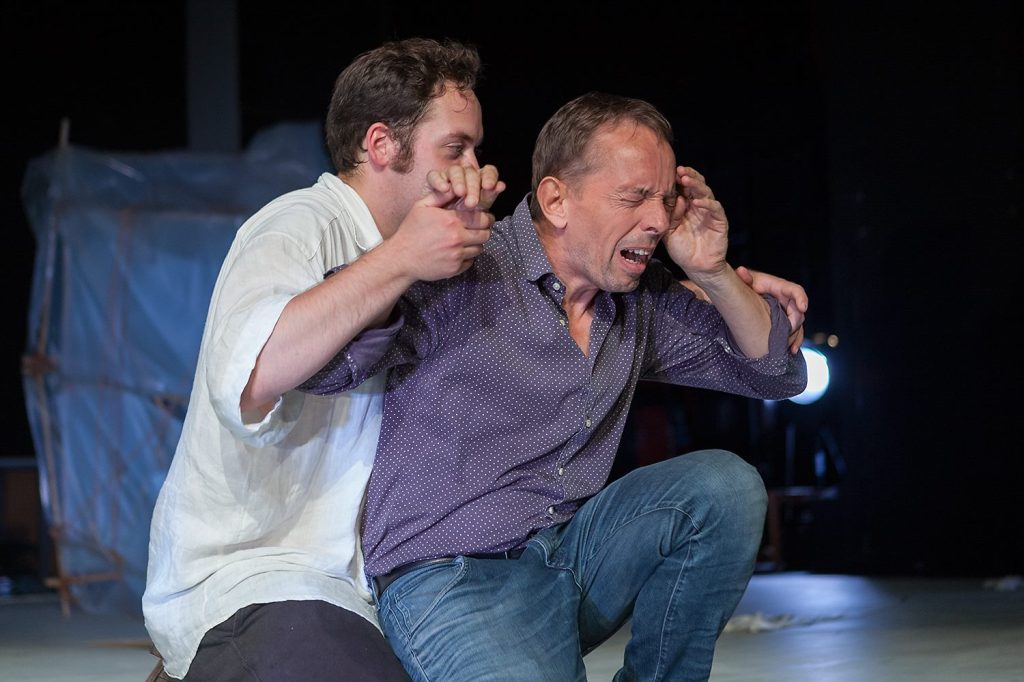
UNI.T – das Theater der Universität der Künste Berlin. With Jonas Böhm. Foto: Thomas Jäger
Opera-Views: How do you balance limited budgets with sustainable, future focused development of singers? What is your success-recipe?
Hilbrich: There’s no one-size-fits-all recipe, but two pillars are crucial: long-term contracts to provide stability, and a culture of openness, curiosity, and inspiration. When working with young artists, patience is crucial. Casting requires not only musical intuition but also experience, sensitivity, and foresight. It’s about recognizing exactly what a singer can do at a given moment—and what they’re not quite ready for. When do you step in to support or challenge them? And when do you let go? That level of attentiveness is, to me, a cornerstone of truly sustainable artist development—both artistically and financially.
Opera-Views: What does your ideal audience look like, and what do you hope they take away?
Hilbrich: My ideal audience is vastly diverse—young and old, from every background—feeling welcome as part of a shared cultural community. Theatre can still be what the church once was: a space to pause, reflect, and connect with others. In our digital age, these live encounters are vital. If our work provokes debate, that underscores its relevance—provided we preserve respect and openness. In an increasingly digital world, our theatres must be sanctuaries of real-life connection.
Opera-Views: Bremen is your hometown. What role will it play in your future?
Hilbrich: Bremen shaped me personally and artistically. Theatre Bremen was my creative home. I’d love to return as a guest director, but that decision rests with the incoming leadership. A final production under Michael Börgerding’s tenure is planned for 2026/27, and I hope it proceeds. What comes after? We’ll see—Bremen will always be in my heart.
Opera-Views: Thank you very much Mr. Hilbrich for the conversation, and all the best in your new role as well as in implementing your dreams and vision.
 Singers, Staging, Orchestra