A dazzling deconstruction of toxic masculinity – Verdi’s Otello at Theater Bremen
A murder out of jealousy. A hero on the edge. A love that can’t survive. Giuseppe Verdi’s Otello is directed by Frank Hilbrich at Theater Bremen. It is a powerful, modern work of music theatre. The performance is full of tension, depth, and disturbing relevance.
Music by Giuseppe Verdi
Libretto by Arrigo Boito
Theater am Goetheplatz, Bremen – Premiere on April 13, 2025
By Oxana Arkaeva
Fotos © Joerg-Landsberg
On April 13th, Giuseppe Verdi’s Otello premiered at Theater Bremen in a production directed by Frank Hilbrich.
Hilbrich, who takes over as general director of Musiktheater im Revier in Gelsenkirchen (MiR) starting in the 2026/27 season, relocates the drama of jealousy, intrigue, and murder into a modern, minimalist showroom.
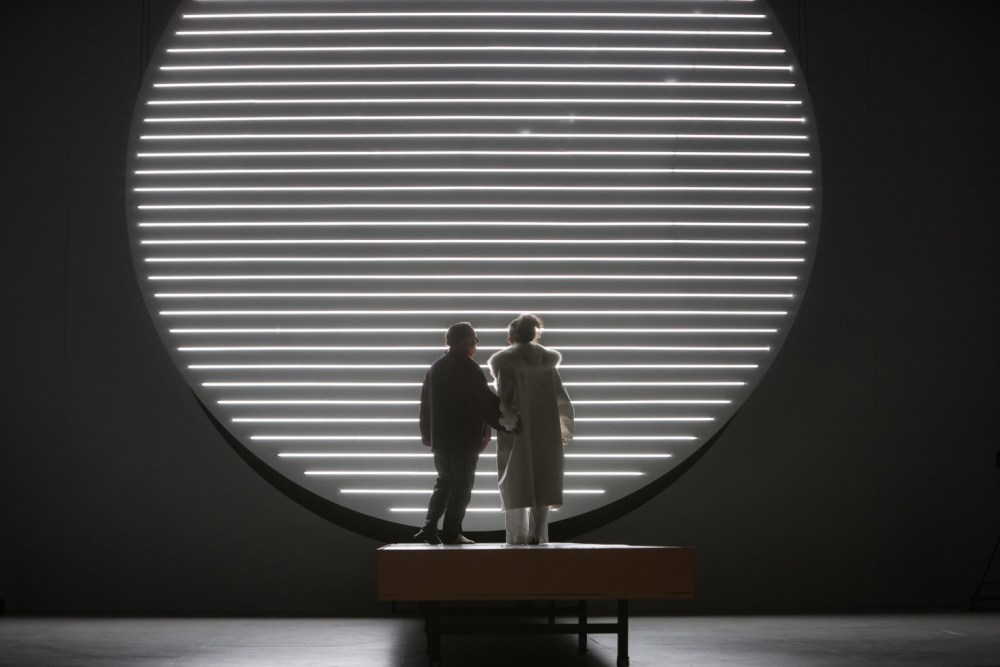
Sebastian Hannak’s sleek stage design, featuring a central runway, evokes the aesthetics of high-end fashion shows. In this stark, performative space, the protagonists either willingly present themselves – or are compelled to submit to the often humiliating gaze of public scrutiny. Christian Kemmetmüller’s artistically precise, sparingly used lighting design acts alternately as a starry sky, a sterile incubator light, or a glowing picture frame, creating striking atmospheric contrasts.
Verdi’s Otello tells the story of a celebrated general who secretly marries the young Venetian noblewoman Desdemona. His ensign Iago, driven by envy and hatred, sows seeds of doubt about Desdemona’s fidelity and manipulates Otello with deadly finesse. In a jealous frenzy, Otello murders his wife – and takes his own life when he realises the truth.
“I cannot escape myself,” Otello says about himself. A bold warrior, an extraordinary man under extraordinary inner pressure – he is an outsider who has never learned to deal with his emotions. His psychological state is the key to the entire opera: he loves – but he does not trust. This makes him the perfect target for Iago, the wolf in sheep’s clothing, who seizes on Otello’s vulnerability with cold calculation.
The question of Iago’s motivation is one of the most fascinating – and disturbing – elements of the opera. This Iago is not a rational avenger, but a radical cynic. “I believe in a cruel God who created me from filth… I believe in evil,” is his credo. Verdi and Boito did not depict him as a conventional villain, but as an abyss. Incapable of empathy, he is deeply convinced, that love, kindness and truth are nothing but illusions. His goal is to annihilate Otello – at any cost. In cold blood he directs his destruction of the loveable hero. Desdemona’s death is not collateral damage, but an essential part of his destructive strategy – a demonstration of his power and his nihilistic belief system.
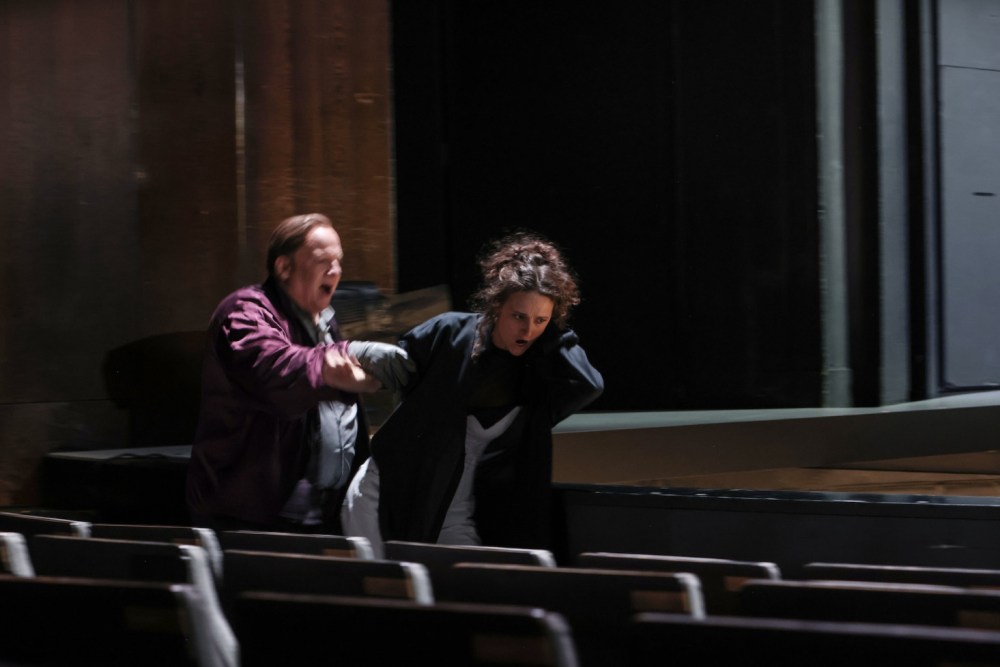
The Bremen production of Otello is frighteningly relevant – perhaps more so than indended. Although composed in the late 19th century and based on a 17th-century play, the libretto deals with themes that deeply resonate today: power, racism, misogyny, violence, identity – and the profound sense of not belonging. The question of skin color is subverted through a deliberate shift in perspective: in this production, Otello is white. The depiction of Desdemona’s femicide – staged in the front row, brutally and inescapably before the audience’s eyes – echoes the tragic realities of frequent partner violence of today. Iago’s psychological cruelty mirrors mechanisms of modern disinformation: a web of half-truths, manipulated perception, and strategic emotional sabotage.

Musically, the production is as well convincing and powerful. Sasha Yankevych, the young first Kapellmeister leads Bremer Philharmoniker this evening with assurance and nuanced dynamic range – from the most delicate pianissimo to thunderous orchestral climaxes. Aldo Di Toro shines in the title role with a powerful, nuanced tenor, expressing Otello’s inner turmoil between love and suspicion with impressive authenticity. His voice is technically superb, well-placed, and brilliant in tone. Adèle Lorenzi’s Desdemona is both graceful and expressive, her soprano capturing the character’s innocence and vulnerability. Her dark timbre at times recalls this of Mirella Freni, yet her interpretation is entirely her own and deeply affecting. Michał Partyka portrays a multi-faceted Iago with a lean baritone, though occasionally lacking vocal force. Particularly noteworthy is Ian Spinetti as Cassio – a vocally and dramatically compelling young tenor, who already hints at being a future Otello.
The excellent chorus of Theater Bremen, prepared by Karl Bernewitz, plays a central scenic role. It functions as the voice of society – first cheering Otello’s triumph, then silently witnessing his moral collapse.
Despite some minor directorial ambiguities – like the underdeveloped roles of Otello’s parents or the recurring child figures – Theater Bremen succeeds in presenting a powerful and musically gripping new interpretation of Verdi’s masterpiece. The presence of many young audience members proves that the theater remains a culturally vital space – a place for emotional resonance, collective reflection, and profound engagement in the here and now.
More information about the production and upcoming performances : www.theaterbremen.de/programm/otello
 Singers, Staging, Orchestra