Standout musical performances shine through controversial production
Performance on August 20, 2024
By Oxana Arkaeva
Production fotos by @Enrico Nawrath
The Bayreuth Festival’s productions of Wagner’s Das Rheingold have evolved significantly over time. Initially adhering to Wagner’s original vision under his family’s guidance, the festival saw a dramatic shift with Wieland Wagner’s “New Bayreuth” style in the mid-20th century. This minimalist approach, focusing on psychological depth, dominated until the 1970s. Patrice Chéreau’s controversial 1976 centennial production, set in an industrial context, marked a turning point and influenced subsequent interpretations. Notable productions followed, including Harry Kupfer’s symbolically rich 1988 staging, Jürgen Flimm’s 2000 contemporary exploration, and Frank Castorf’s complex, multi-layered 2013 interpretation set in a modern capitalist world.
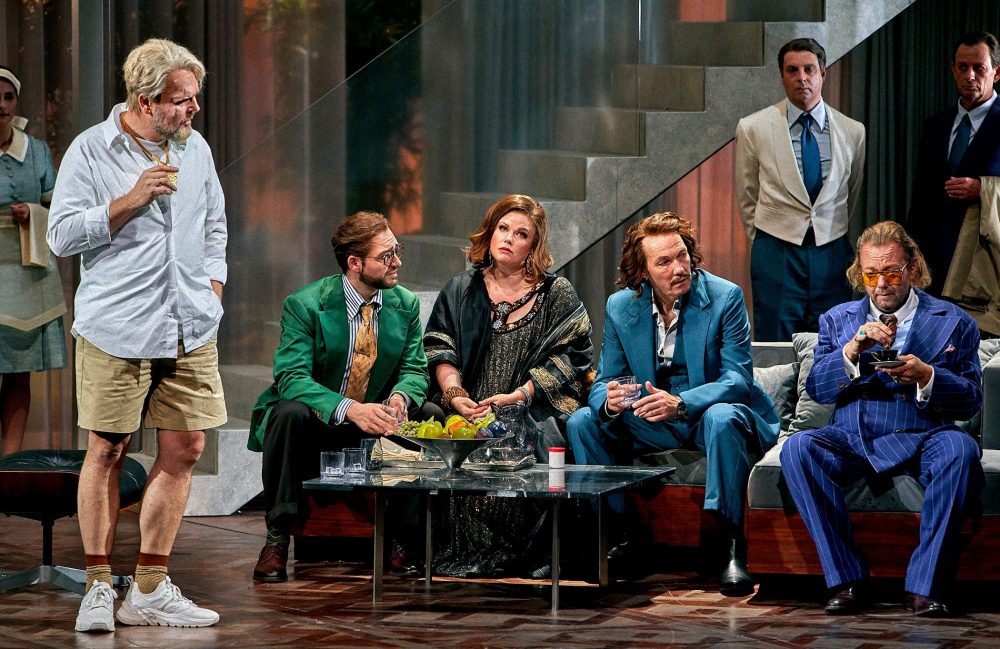
The August 20, 2024, performance revived Valentin Schwarz’s 2022 production, setting the opera in the 21st century with hyper-realistic sets and costumes. The staging was laden with modern and symbolic elements, such as a surreal video of two fetuses connected by umbilical cords. The Rhinemaidens (Evelin Novak as Woglinde, Natalia Skrycka as Wellgunde, and Marie Henriette Reinhold as Flosshilde) were reimagined as maternal figures interacting with children, adding a nurturing dimension to their roles. The giants, Fassolt and Fafner, were portrayed as mafia figures, while Loge became a modern businessman, perpetually on his phone. The central symbol of the Ring was transformed into a human boy dressed in a yellow tricot, whose kidnapping by Alberich illustrated innocence corrupted by greed. This human Ring, later replaced by a girl and traded to the mafia giants, evoked themes of human trafficking and child exploitation—a rare but striking moment of impactful staging.
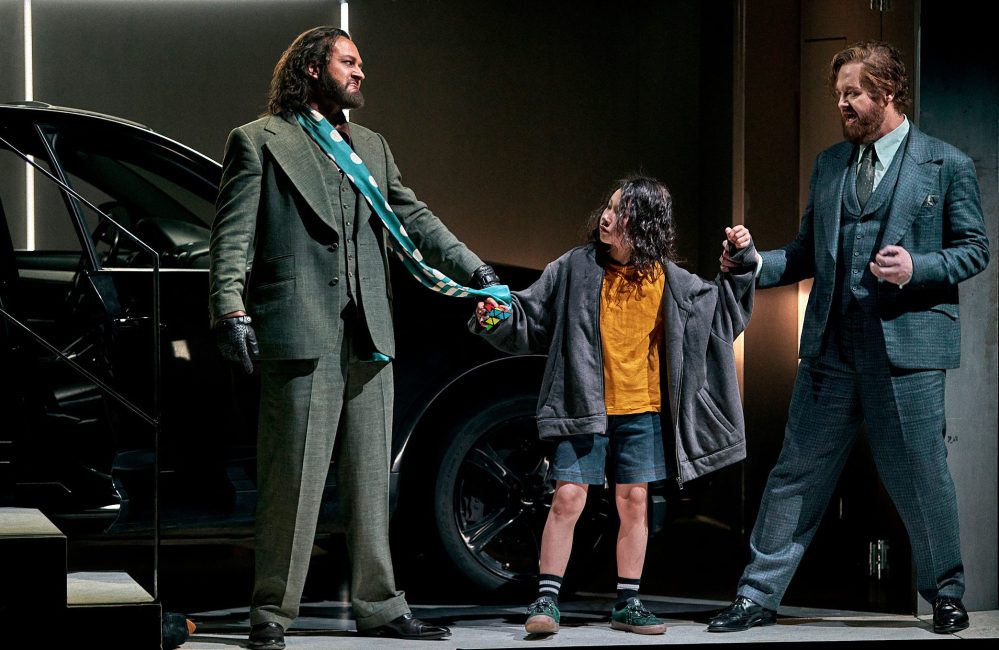
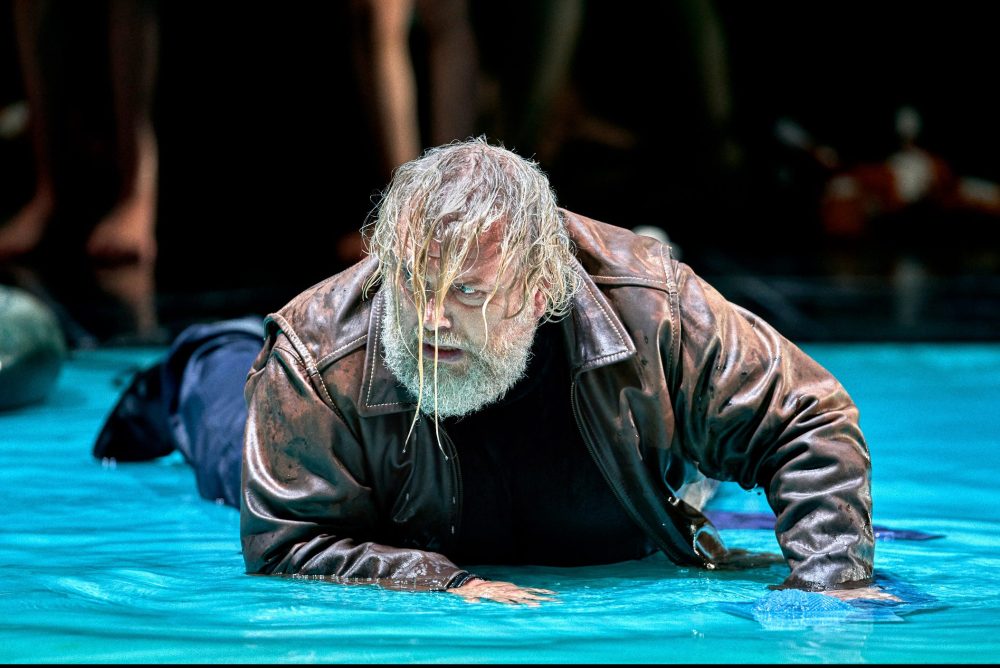
Vocally, the ensemble was robust, with several standout performances. Ólafur Sigurdarson’s Alberich transitioned convincingly from naivety to greed, his powerful voice and dynamic acting overshadowed only by occasional vocal strain. Christa Mayer’s Fricka commanded attention with her remarkable diction and authoritative presence. Christina Nilsson’s Freia, while vocally exquisite, suffered from a poorly conceived visual portrayal. Tomasz Konieczny’s Wotan, humanized as a drunkard, delivered a vocally uneven performance, often marked by fatigue and unclear diction.
John Daszak’s Loge brought humor and vocal agility to the role. Jens-Erik Aasbø (Fassolt) and Tobias Kehrer (Fafner) impressed with their commanding bass voices and authentic portrayals. Ya-Chung Huang’s Mime delivered one of the evening’s most compelling vocal performances, while Mirco Roschkowsky’s Froh, a Bayreuth newcomer, stood out with a bright tenor and precise diction. Nicolas Brownlee’s Donner contributed strong vocals, and Okka von der Damerau’s Erda was vocally proficient but suffered from staging that lacked the mysticism traditionally associated with the role. Simone Young led the orchestra in a remarkable performance, characterized by clarity and rhythmic precision, despite some coordination issues.
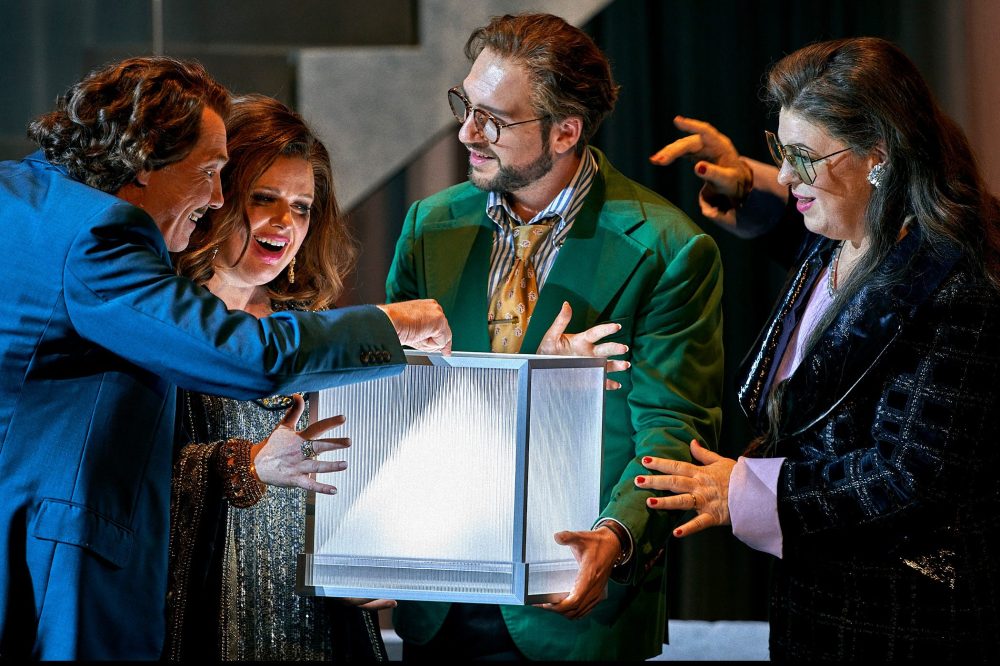
While the production offered a fresh and ambitious take on Wagner’s work, it struggled to effectively convey the opera’s story. The staging by Valentin Schwarz created a disconnection between the visual narrative and the text, leading to an overall unattractive presentation despite notable performances by singers and orchestra. The production’s attempt to balance innovation with fidelity to the original opera plot fell short, resulting in a performance that, while vocally strong, failed to capture the essence of Wagner’s masterpiece.
 Singers, Staging, Orchestra