From Lake to Indoor Stage: Der Freischütz’s in Bregenz
Bregenz Opera Festival
Performance on August 18th, 2024
By Oxana Arkaeva
The performance of Der Freischütz at the Bregenz Festival on August 18th, 2024, encountered significant challenges due to inclement weather, requiring a last-minute move to the Great Hall. This decision, made despite the adverse weather being known days in advance, led to frustration as the audience was left waiting in the rain and even longer in the foyers. The relocation also caused disruptions during the performance, with audience members entering and exiting mid-show, creating a distracting atmosphere.
The move to the Great Hall did not favor Philipp Stölzl’s acclaimed cinematic staging, which lacked a contingency plan for an indoor adaptation. Stölzl’s reinterpretation involved replacing Friedrich Kind’s original libretto with a new version by Jan Dvořák, expanding Samiel’s (excellent performance by Moritz von Treuenfels) role into an omnipresent narrator, and altering some sections into spoken dialogue. This shifted the focus, turning the opera into a play with musical interludes, which detracted from the traditional balance between music and dialogue. Additional incidental music by Ingo Ludwig Frenzel was used, further distracting from Weber’s original score. These modifications, while ambitious, ultimately detracted from the coherence and impact of the performance. Especially in the concert version.
Stölzl’s modernization efforts also extended to the female characters, moving away from 19th-century stereotypes. Agathe was portrayed with a multi-layered interpretation, adding complexity by being pregnant and eager to marry Max. Ännchen underwent a radical transformation into an emancipated modern woman with lesbian tendencies, adding depth to her character.
The singers, fatigued from the delays, struggled to deliver their best performances. Elissa Huber as Agathe had a lovely soprano voice but struggled with high notes. Gloria Rehm’s Ännchen had a small voice, making dialogues hard to understand. Oliver Zwarg’s portrayal of Kaspar stood out with a strong bass-baritone voice and excellent diction, while Thomas Blondelle as Max improved over the evening, singing with a likable tenor voice.
The Great Hall’s acoustics posed further coordination challenges for the Vienna Symphonics, which were well-managed under Erina Yashima’s guidance. The Prague Philharmonic Choir placed far back, performed well, though the famous hunters’ chorus was acoustically diminished and lacked its usual dynamic impact.
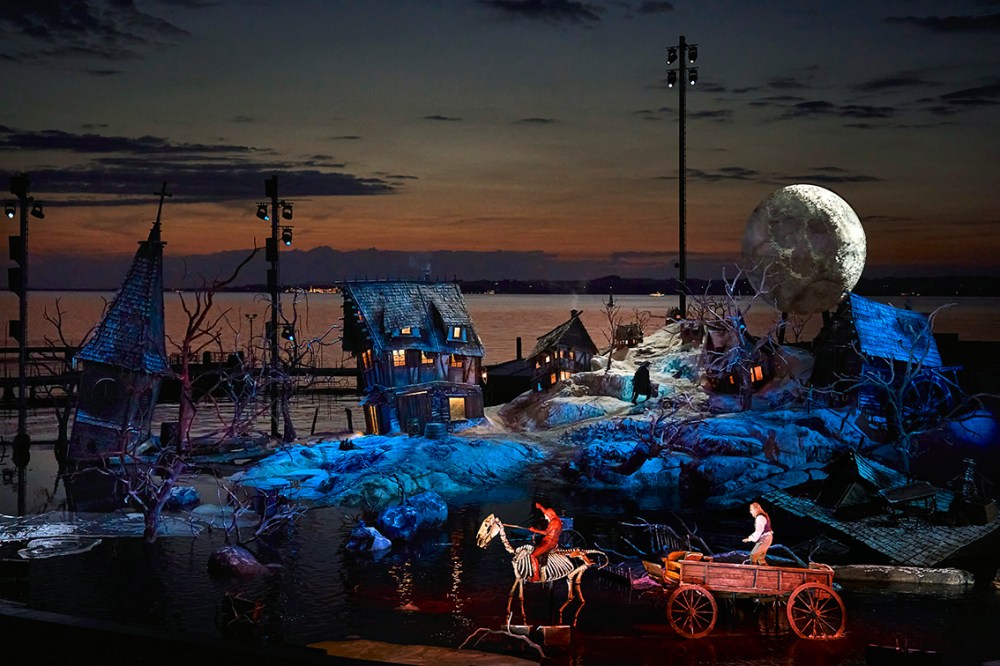
Overall, while the performers and production team did their best under the circumstances, the lack of a clear plan for weather-related disruptions significantly detracted from the quality of the performance and left one with a less-than-satisfactory experience. One can only hope that next summer will bring more favourable weather conditions and allow us to experience this production in its full scenic power amidst the spectacular stage surrounded by no less spectacular scenery of Lake Constance.
The revival f the production will take place on July 17th, 2025 as a part of the fist season of the new intendant Lilli Paasikivi
 Singers, Staging, Orchestra