Puccini’s Emotional Rollercoaster and Asmik Grigorian’s Triple Triumph
Performance on August 18th, 2022
By Oxana Arkaeva
Production fotos @Monika Ritterhaus
A warm summer evening and a busy occupied forecourt in front of the Festspielhaus. The streets are filled with festively dressed crowds of an international audience and exciting, anticipatory chatters. This evening, Il Trittico (The Triptych) by Giacomo Puccini featured Asmik Grigorian in all three female leading roles. The Lithuanian soprano had her big break in Salzburg in 2018 with Salome by Richard Strauss. Four years later, her extraordinary performance in the roles of Lauretta, Giorgetta, and Suor Angelica is frenetically celebrated by the packed audience.
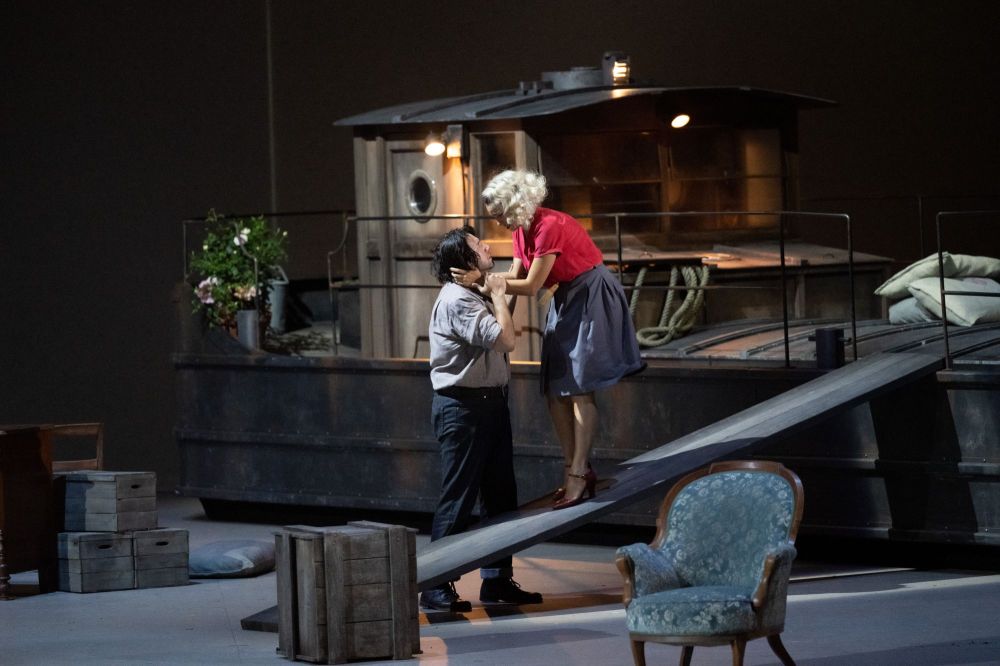
Love longing, denial, murder, and death are the connecting motifs of Puccini’s trilogy. Stage director Christof Loy and conductor Franz Welser-Möst presented an atypical placement of each opera in their version of the Il Trittico. The evening began with Gianni Schicchi, followed by Il Tabarro as the centerpiece and Suor Angelica at the end of the evening. The triptych-like arrangement of Puccini was thus broken up to make Asmik Grigorian in all three roles at the center of the production and to allow her to build up her singing and acting powers. This decision formed dramaturgically (Yvonne Gebauer) a common thread intending to establish the joint pattern of events and to unite these three quite different stories to become one. The theme of death, each as well in three different ways, forms another common thread in this production.
The strong ensemble of singers with Grigorian as the star of the evening and the bombastic orchestra make this concept work and production an enormous success. A distinguishing feature of the staging is a consequent and conscious reduction of the attention towards the characters and their stories without falling into slapstick as well as the simplicity of the stage design (Etienne Pluss), the light (Fabrice Kebour), and costumes (Barbara Drosihn).
Loy makes his singers act sparingly and shifts the dramaturgical accent towards the portrayal of the characters, their life stories, and emotional puzzlement. Thus, in Gianni Schicchi young Lauretta fights for love for her boyfriend and her happiness amid a grotesque inheritance dispute. In Il Tabarro we encounter the desolation of a Parisian suburb. Here we meet a young married woman who, after the tragic death of her son, has distanced herself from her husband and started an affair with a young worker—their shared dreams of a better life end in a tragic murder. In Suor Angelica, we encounter the calmness and order of monastic life. Amongst busy nuns, we meet a young woman, Angelica, who entered the convent to escape the disappointments of life and societal judgments. As a nun, she hopes to find peace and protection here. However, at once the peaceful life of the convent is brutally infiltrated by the outside world. After the announcement of the death of her illegitimate child, Angelica is thrown back into reality and commits suicide. Asmik Grigorian masters the vocal challenges of all three parts with impressive acting and singing sovereignty. Vocally, she bestows all three roles with an individual sound, and powerful top notes, and does not shy away from a rough-sounding chest voice.
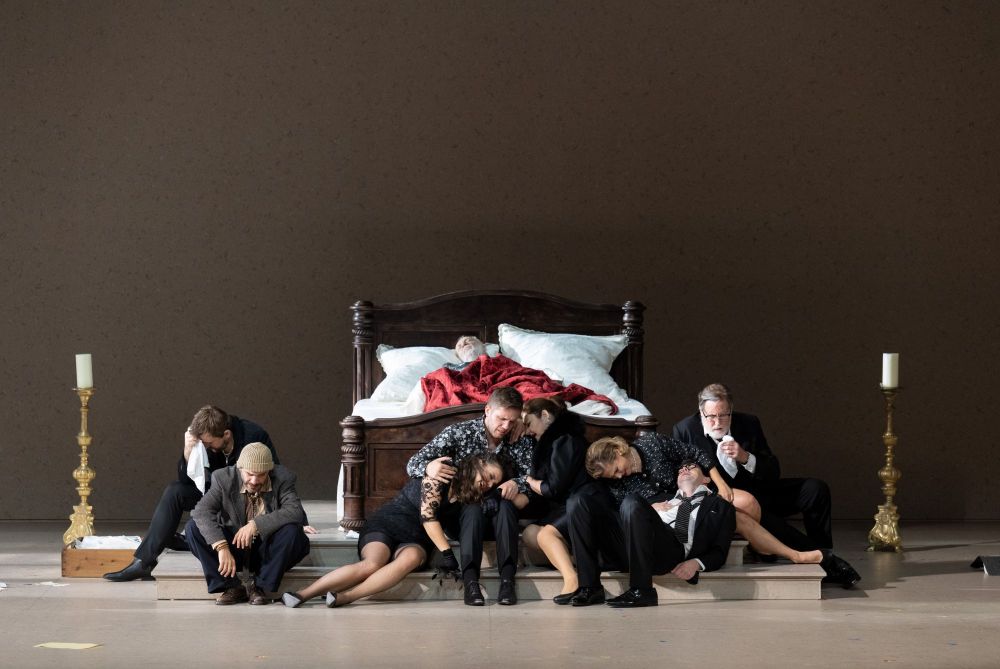
The rest of the singer’s ensemble is not inferior to her in terms of vocal intensity and acting. In Gianni Schicchi Misha Kiria impressed as a grandiose Gianni Schicchi, both vocally and in acting. Alexey Neklyudov as Rinuccio presented a beautiful lyrical tenor voice. Groseida Shkosa (Zita), Dean Power (Gherardo), Lavinia Bini (Nella), Manel Esteve Madrid (Betto di Signa), Scott Wilde (Simone), Iurii Samoilov (Marco), Caterina Piva (La Ciesca), Matteo Peirone (Maestro Spinelloccio), Mikołaj Trąbka (Ser Amantio di Nicolao), Aleksei Kulagin (Pinellino) and Liam James Karai (Guccio) formed in Gianni Schicchi an excellent ensemble of singers, who had a lot of fun on stage.
In Il Tabarro two main male characters build together with Giorgetta a tragic love triangle. Roman Burdenko delivers impressive performances as jealous, but at the same time vulnerable husband Michele and Joshua Guerrero as young, passionate lover Luigi. Both impressed with excellent baritone and tenor voices and authentic acting. Even though the Mexican tenor sometimes sounds like a young Pavarotti, his voice possesses a distinguishing drama and captivating power. Andrea Giovannini (Il Tinca), Scott Wilde (Il Talpa), Groseida Shkosa (La Frugola and later as La Suora Zelatrice), Dean Power (Un venditore di canzonette/Un amante) and Martina Russomanno (Un’ amante und later as Suor Osmina) also form a strong ensemble of singers, although Russomanno stands out with a beautiful soprano voice.
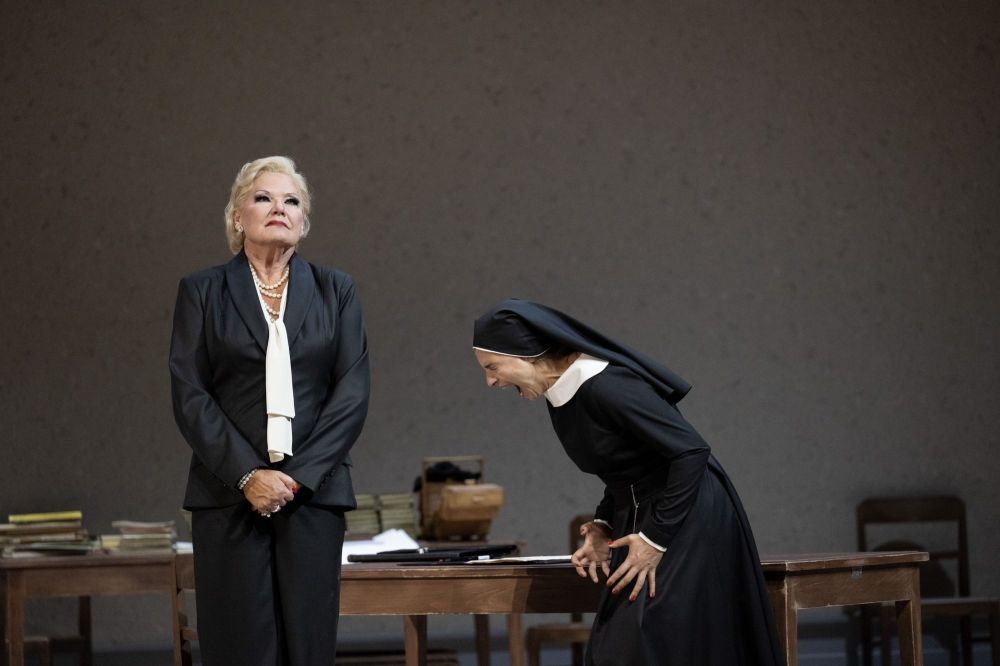
In Suor Angelica, the action centers around Asmik Grigorian as Angelica and Karita Mattila as La Zia Principessa. They form a strong duo in terms of acting and singing. Both pose an enormous stage presence, although Mattila had some trouble in the low register. Hanna Schwarz (La Badessa), Caterina Piva (La Maestra delle Novizie), Giulia Semenzato (Suor Genovieffa), Daryl Freedman (Suor Dolcina), Juliette Mars (La Suora Infermiera), Lavinia Bini (Prima Cercatrice), Alma Neuhaus (Seconda Cercatrice ) and Amira Elmadfa (Novizia) frame the drama with delicate playing and beautiful voices.
A large part of the success of this production is due to the great performance of the Vienna Philharmonic Orchestra and its conductor. One would not necessarily picture Franz Welser-Möst as the ideal Puccini conductor. The controlled emotions, frugality, and concentration of his conducting seem to be more suited to the music of Richard Strauss than to the dramatic power, darkness, and tragedy of Puccini’s orchestral score. However, it was precisely this control, frugality, and concentration that gave the evening an extraordinary musical and dynamic intensity and power. At the end of the evening, Asmik Grigorian stepped onto the front stage to be showered by thunderous applause and frenetic “Bravas”. The enthusiasm of the audience increased when the whole ensemble, a total of around 50 participants including the conductor, came on stage to take a final bow. All were relieved and happy about the successful evening and sold-out auditorium. A truly great evening at the opera that will be remembered for times to come.
 Singers, Staging, Orchestra